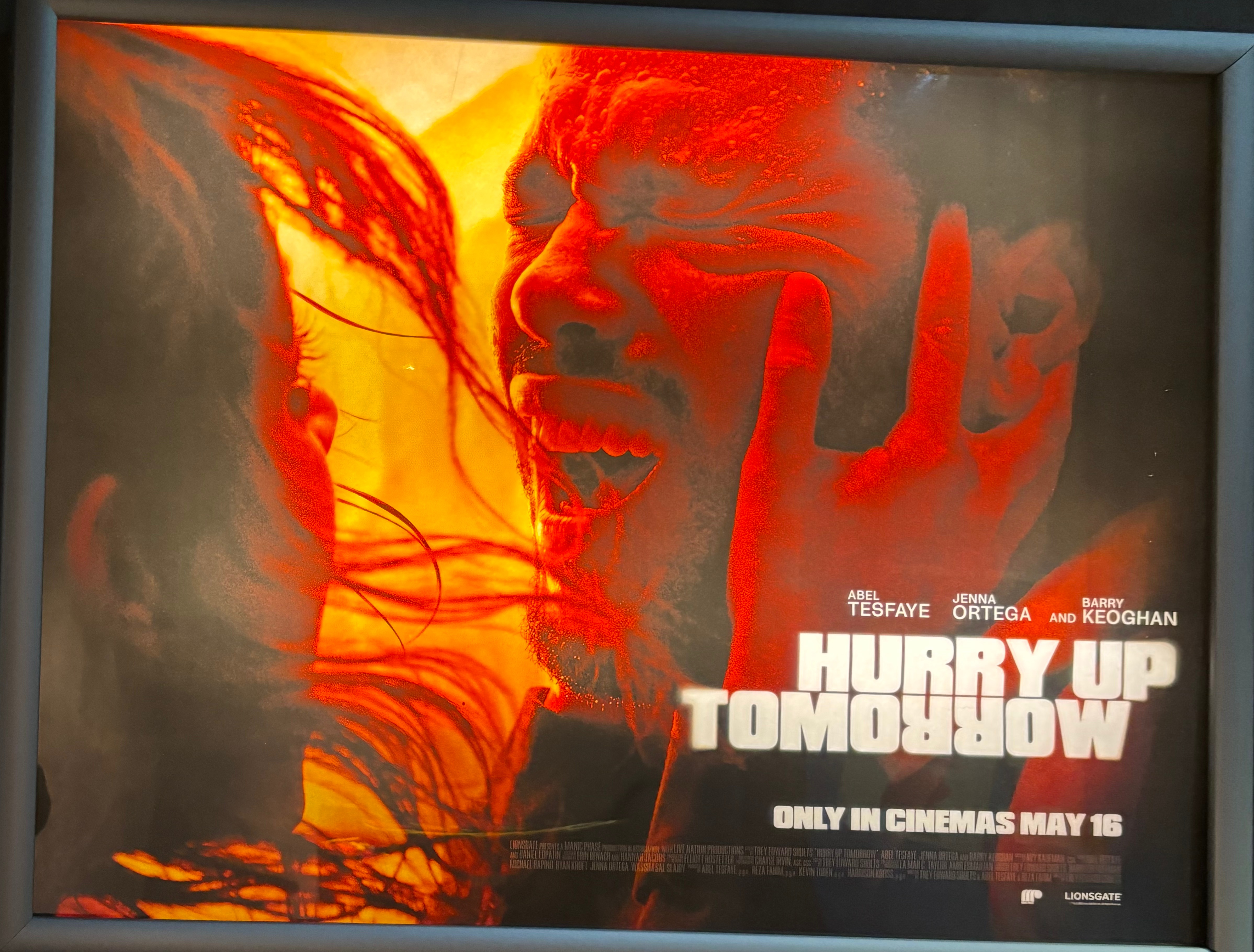
It’s been a year since Abel (The Weeknd) Tesfaye starred in his first feature film, based on events that happened to him, but is it as bad as everyone says it is?
- Director – Trey Edwards Shults
- Runtime – 105 minutes
- Certificate – 15
- Country – United States
Surprisingly I don’t actually think it is as bad as everyone says it is. The film is unapologetic and a polarizing experience. It sticks to what it wants to be and rarely wavers. This type of move to make for an artist is extremely experimental but it just needed that extra bit of confidence.
The reason I don’t think it’s that bad is because I can see past its flaws (more later). A lot of people don’t give this film credit, but it does deserve some flowers. The obvious one is its music. Having The Weeknd star and compose the score along with Daniel Lopatin (OPN, who did the score for Uncut Gems and Marty Supreme) means that the chance of the music being bad almost impossible.
The soundtrack are just songs from Abel’s album of the same name, which are narratively linked, but the score really surprised me. Following with Abel’s recent work it is extremely synth heavy fluctuating from soft dream like synths to more aggressive and hard hitting synths. But it also becomes more traditional at times with the track ‘Anima Pt. 2’ having these evil sounding organs playing.

Throughout its runtime it is genuinely one of the best looking and sounding films from last year. Shot on 35mm by its DP Chayse Irvin, the cinematography is fantastic. It’s dreamlike and surreal, similar to the score, but it also isn’t afraid to be in your face and aggressive. Done with rapid camera movements, shaky cameras and maybe one too many car spins to get you into the headspace of Tesfaye’s character. You are experiencing what he is experiencing.
These scenes make you uncomfortable, they are unpleasant and drag you through the mud. They last longer than what most filmmaking rules would dictate but the film isn’t afraid to do that because above all this is a visceral experience that is meant to be felt.
But it also has these intimate moments between Tesfaye and Jenna Ortega’s Anima. Combining the dream like score and cinematography it creates these hypnotic scenes that make watching them feel almost transcendent. The scene between them where they are at the arcade with the ‘I Feel Like I Know You’ score which then transitions into Tesfaye’s ‘Drive’ gives me this euphoric feeling that I just can’t quite describe. The only problem with the scenes like this are that they don’t really add anything to the plot which allows for the argument of style over substance to be made
Arguably the biggest talking point of the film is the acting. The only other project that Tesfaye has starred in was ‘The Idol’ and that had about the same critical and audience reactions as the film which was that he cannot act. Suprisingly again I don’t think he actually is that bad, he isn’t the best but the difference between this and ‘The idol’ is night and day.
I do think there a few scenes where he shows promise such as the performances of ‘Wake Me Up’. The first time he is very confident and performing as he would in real life but the second time shows a clear difference. This second performance he is going through a mental breakdown where everything bad in his life is catching up to him and he finally loses his voice.
To reenact one of, if not the most, traumatic moment of your life this convincingly is impressive.
Scenes of that nature do give me hope for his acting career, he just needs to stop taking these heavy roles that do not have the best script. Ironically, it’s actually his voice that hinders his acting for me. He takes on these quite dramatic and demanding roles that require him to have this sort of presence so when he has to shout and when he opens his mouth and it’s this smooth higher pitched voice it completely takes you out of it. Jenna Ortega gives the best performance but considering that Barry Keoghan (Lee) is barely in it, the bar isn’t exactly high.

The performances are not perfect though and a fault of these performance comes from the script and that is being generous because there is barely a script. This is easily the biggest fault the film has. Written by Tesfaye, Trey Edwards Shults and Reza Fahim, it delves into the psyche of a fictionalised version of Tesfaye where Ortega and Keoghan play aspects of his mind (taking inspiration from Carl Jung), but Abel barely has any lines of dialogue. And when there is dialogue it comes off as edgy and underdeveloped with it adding no depth to the characters.
This is where being a fan of Tesfaye comes into play because I know the backstory behind the film and the inspiration, so to me it does have depth and meaning but not to the general public. They are playing catch up because they haven’t followed his career and the narrative woven into his music.
This can be applied to the story. It’s based on when Tesfaye lost his voice at the start of a concert in front of 80,000 fans. From there it, again, delves into his psyche about why this happened and how his self-destructive lifestyle has led to this. The films inspirations are incredibly clear with the main one being Ingmar Bergman’s 1966 Persona, where there isn’t a set objective but more of a character study. The problem is that Persona is a very dialogue heavy film (from one character anyway) whereas this is not.
The lack of dialogue doesn’t affect fans of Tesfaye because they understand the little details and nuances but the general audience don’t. While they can still understand what’s going on and the themes behind the film, the emotional climax at the end will not have the same impact for them. Which is a shame because I genuinely think that the ending is great but the build up to it just isn’t there in the script.

This is an incredibly personal film to Abel as him and Shults have said in interviews that the script we got didn’t have many renditions and was finished quite quickly, which is obvious. Was it cathartic for him to be able to express his feelings in this way? Absolutely. But this level of depth doesn’t work as a screenplay.
Hurry Up Tomorrow is a uniquely experimental and visceral experience that takes big swings in making you uncomfortable but also sit in these intimate moments with the score and cinematography working symbiotically. But ultimately it needs that extra bit of depth in the script.
Hurry Up Tomorrow is currently available to stream on Prime Video.